 Dossier
 Margin
Claude Ship, read closely
Anthropic’s new agents review, fix and approve GitHub pull requests. The launch post sells speed; the docs carry the defaults that decide what merges unread and what bills unseen.
Certificate of release, for pilot only
as at 24 Nov 2026Claude Ship is safe to trial if you set it up the way its docs describe, and risky if you take its defaults; nobody has published a measurement of how well it works.221
- It’s three agents on GitHub pull requests: Code Review finds problems, PR Steward pushes fixes, and Claude Approvals decides who still has to approve.1
- Observe mode, the trial mode Anthropic recommends, is billed, and switching off usage credits doesn’t stop an agent that’s on.92
- The author of a pull request can fill an approval seat, so a policy asking for one person asks nobody else to look.12
- The docs say a pull request’s own text can steer the classifiers a policy reads, and a steered answer can lower what it needs.12
A real per-review bill from your own repository, or the first reports of a bad approval or a steered classifier. The only price on record is still March’s research-preview average of $15–25 a review.16
One repository, Code Review on pull-request creation with a spend limit, PR Steward on request only, Approvals in observe mode with a rule no classifier can lower, branch protection switched on first.69
Three agents and a command, and only one of them can approve
Claude Ship launched in beta on 23 November for Claude Team and Enterprise organisations with repositories on GitHub.1 It’s a bundle of three agents that hand a pull request along: Code Review reads the change and posts findings, PR Steward pushes commits to fix failing checks, conflicts and comments, and Claude Approvals applies a policy file your team writes and reports who still has to approve.2
Only Approvals can approve. Anthropic’s service refuses an approval from a PR Steward session, and Code Review’s check never concludes as a failure, so on its own it neither blocks nor passes anything.73
| Part | Status | Runs as | Billed to |
|---|---|---|---|
| Code Review | Generally available | Claude GitHub App, read-only on the repo | Organisation, per token4 |
| PR Steward | Beta | Cloud session in auto mode, as the GitHub App | Organisation, no limit until set5 |
| Claude Approvals | Beta | A check run, plus an approving review where allowed | Organisation, for reviews and classifier runs8 |
| /ship, /steward | Rolling out | Your CLI session, with your gh and git sign-ins | Your own Claude Code usage13 |
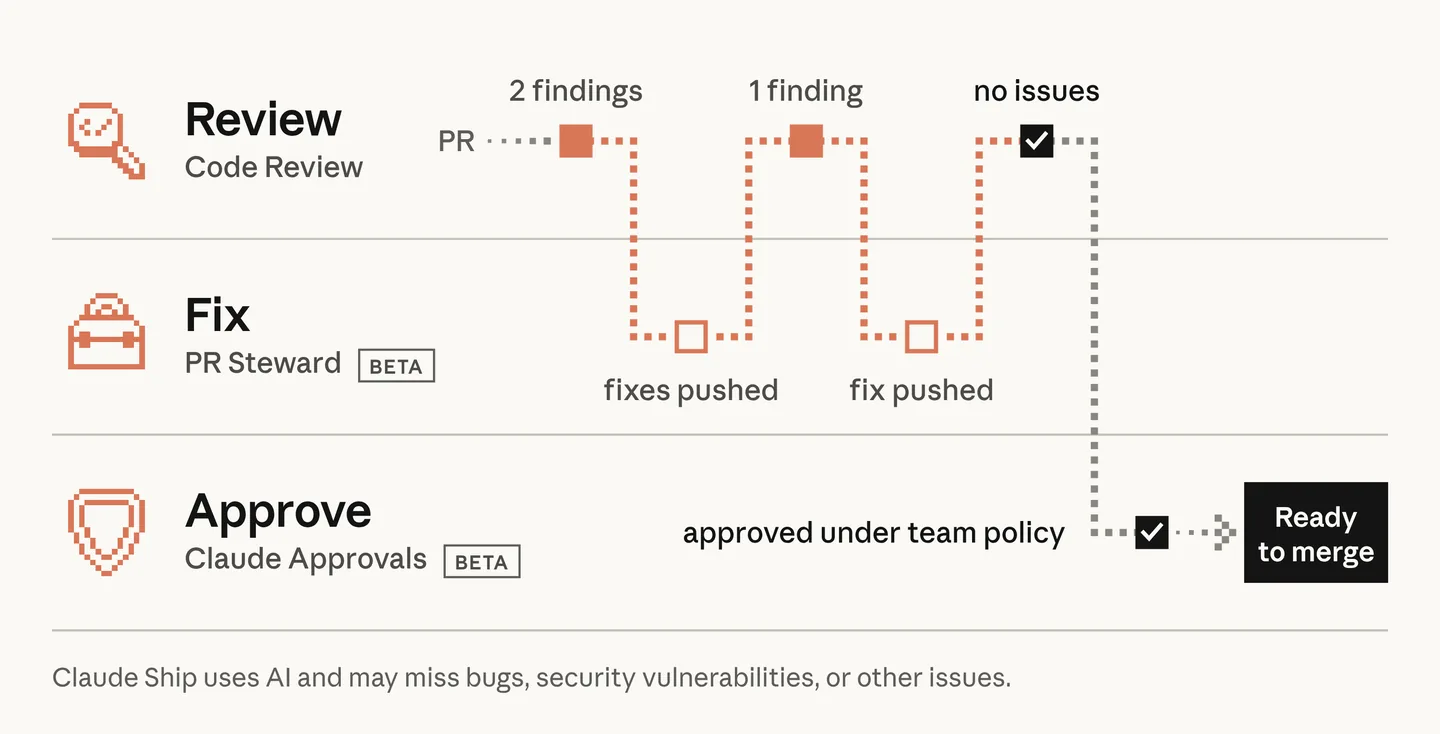
The case Anthropic makes is its own team’s record: on the Claude Code team, merged pull requests more than doubled from June to September while the share reverted fell by more than 40%, with Code Review described as one layer of a broader process.1 That’s the vendor measuring itself, not a controlled trial of Ship. The launch post also quotes TELUS, which keeps “a human in the loop”, and Carvana, which is piloting PR Steward.1
The docs, not the launch post, carry the ten defaults that decide what merges and what bills
The announcement says teams “stay in control of where it runs and which changes need a person”.1 That’s true once someone has written the policy, set the spend limits and kept the right branch rules. Until then, these defaults apply. Each one is listed the way a maintenance log lists a deferred defect: what it does, and the procedure that makes it safe to carry.
-
D-01Bills unseen
Observe mode is billed.
A policy that reads Code Review’s result can start a billed review at pull-request open and at every push, on top of what your Code Review settings ask for. Custom classifiers bill on every run, including runs that end with no answer and automatic retries after an error.911
(M) Keep
claude/code_reviewunderadvisoryrather than in a condition, and set the classifier-runs spend limit before the first policy merges. -
D-02Bills unseen
Switching off usage credits doesn’t stop an agent.
The overview page says an agent that’s on “keeps running and billing your organization”.2
(M) Turn agents off in the documented order: Approvals, then PR Steward, then Code Review, because a policy can start billed reviews where Code Review is off.
-
D-03Bills unseen
New repositories review after every push, and Steward has no ceiling.
A repository added from the admin page starts with Code Review on “After every push”, the setting that runs the most reviews, and PR Steward has no monthly limit until an Owner sets one.46
(M) Set reviews to “Once after PR creation” and give Steward both a monthly limit and a per-PR cap; the docs note spend can pass the cap before it stops.
-
D-04Merges unread
A policy file switches automatic reviews off.
Once
.claude/approvals.ymlis on the default branch, automatic Code Reviews stop on every file it covers unless a matching rule namesclaude/code_review. That holds in observe mode too.8(M) Keep the
advisory: [claude/code_review]line from the starter policy in every rule. -
D-05Merges unread
The author can fill an approval seat.
On a pull request opened by someone with write access, “the author alone can meet
seats: 1“, andseats: 0lets a bot’s pull request merge with no person at all. A machine user counts as a person.1012(M) Write the seat as
{ count: 1, from: [humans, "!pr/authors"] }, and exclude any agent’s machine-user login by name. -
D-06Merges unread
Claude can approve a change nothing has read.
A rule that says
claude: approvesstarts no review by itself.8(M) Only let Claude approve inside an override gated on
claude/code_review = pass, as the starter policy does. -
D-07Merges unread
Pull-request text can steer a classifier.
A classifier reads the title, description and diff the author wrote. The docs say that text “can steer a classifier’s answer”, and where a rule reads that answer, a steered one can lower what the pull request needs.1211 No incident had been reported when I checked; the exposure is documented, not observed.
(M) On paths that matter, add a rule that reads no classifier and asks for one person who isn’t an author.
-
D-08Merges unread
GitHub counts Claude’s approval, and trusts any check with the right name.
Claude’s approving review satisfies a branch rule that requires one approval, and GitHub keeps counting it on an old commit until it’s dismissed. A required check left on “any source” accepts a check named Claude Approvals from anything that posts one.129
(M) Turn on “Dismiss stale pull request approvals”, require no more than one GitHub approval and put the real head count in
seats, and pin the check’s source to app ID1236702. -
D-09Merges unread
Auto-merge and merge queues finish the job with nobody watching.
With either switched on and a policy that requires no person, a change merges without anyone acting. Approvals stamps a merge queue’s commits as passed without evaluating them.12
(M) Keep a classifier-free non-author rule on every path before turning either on.
-
D-10Merges unread
Some of the files that steer review aren’t protected.
The built-in protected list covers policy and classifier files, root
REVIEW.md, git metadata andCODEOWNERS. It doesn’t cover.github/,CLAUDE.md,AGENTS.mdor.mcp.json, and a change to a protected file can be approved by its own author.10(M) Write rules for those paths yourself, asking for a non-author.
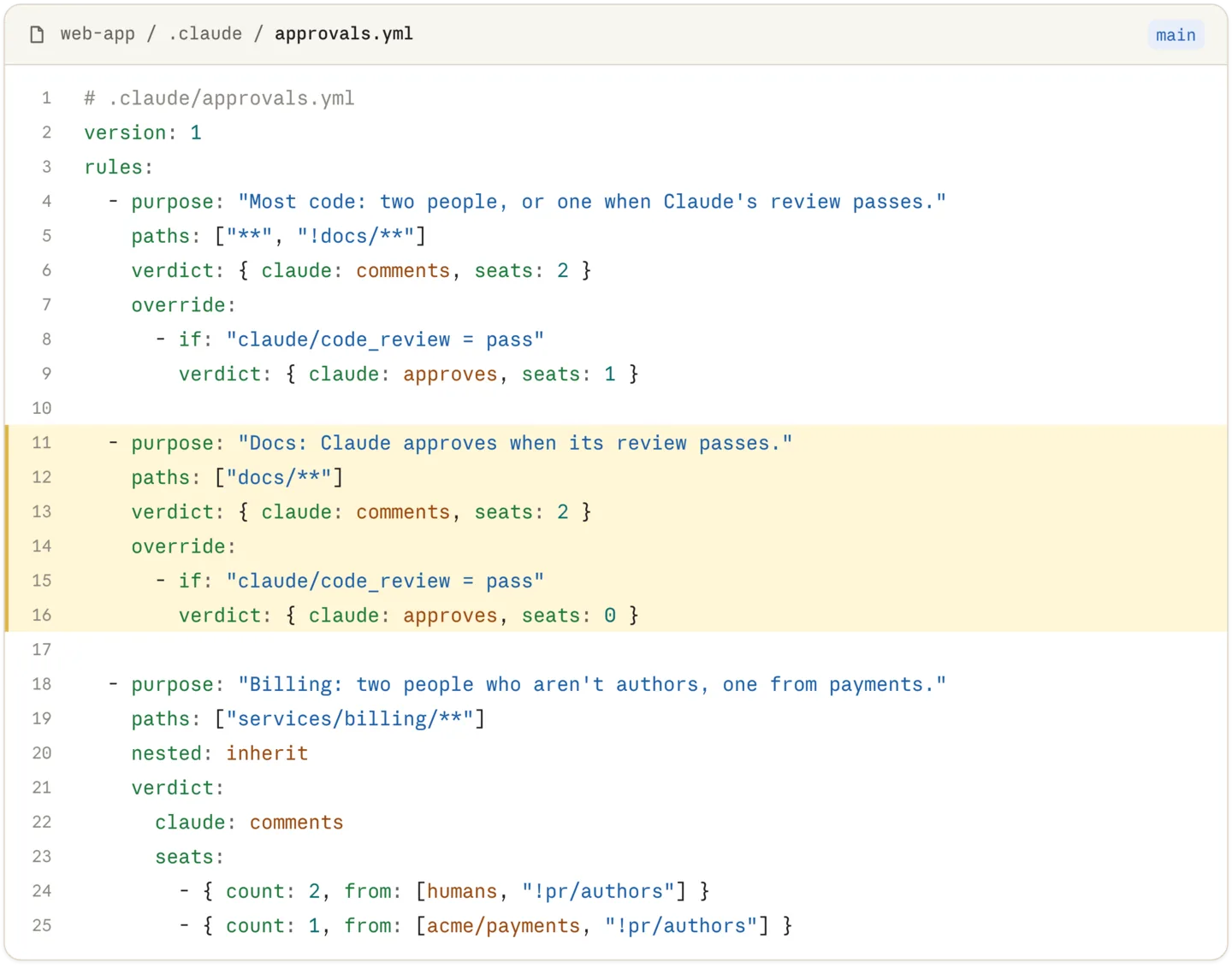
Note: Enterprise organisations can claim promotional credits worth $10,000 to $50,000, set by active Claude Code seats, usable for 30 days from a single claim made before 23:59 UTC on 15 January 2027. They don’t cover /ship or /steward, and the clock starts at the claim whether or not reviews are running, so connect repositories first.14
PR Steward’s limits are mostly GitHub’s limits
PR Steward starts when a pull request opens, is reopened or leaves draft, in repositories where an Owner has switched it on; it skips drafts, forks, bot-opened pull requests and authors without write access.5 Anthropic’s service refuses four things from a Steward session: approving, changing branch protection or statuses, deleting a branch and pushing tags.7
Everything else is left to your branch rules. A session can push to any branch the Claude app may push to, not only the pull request’s, and on github.com the app can hold write access to workflow files. Merging, auto-merge and force-pushing are blocked by permission rules that match a command’s text and by auto mode’s model check, and the docs concede that “a command that’s written another way can pass both”.7 The control that holds is a ruleset requiring an approval, with the Claude app kept off every bypass list.6
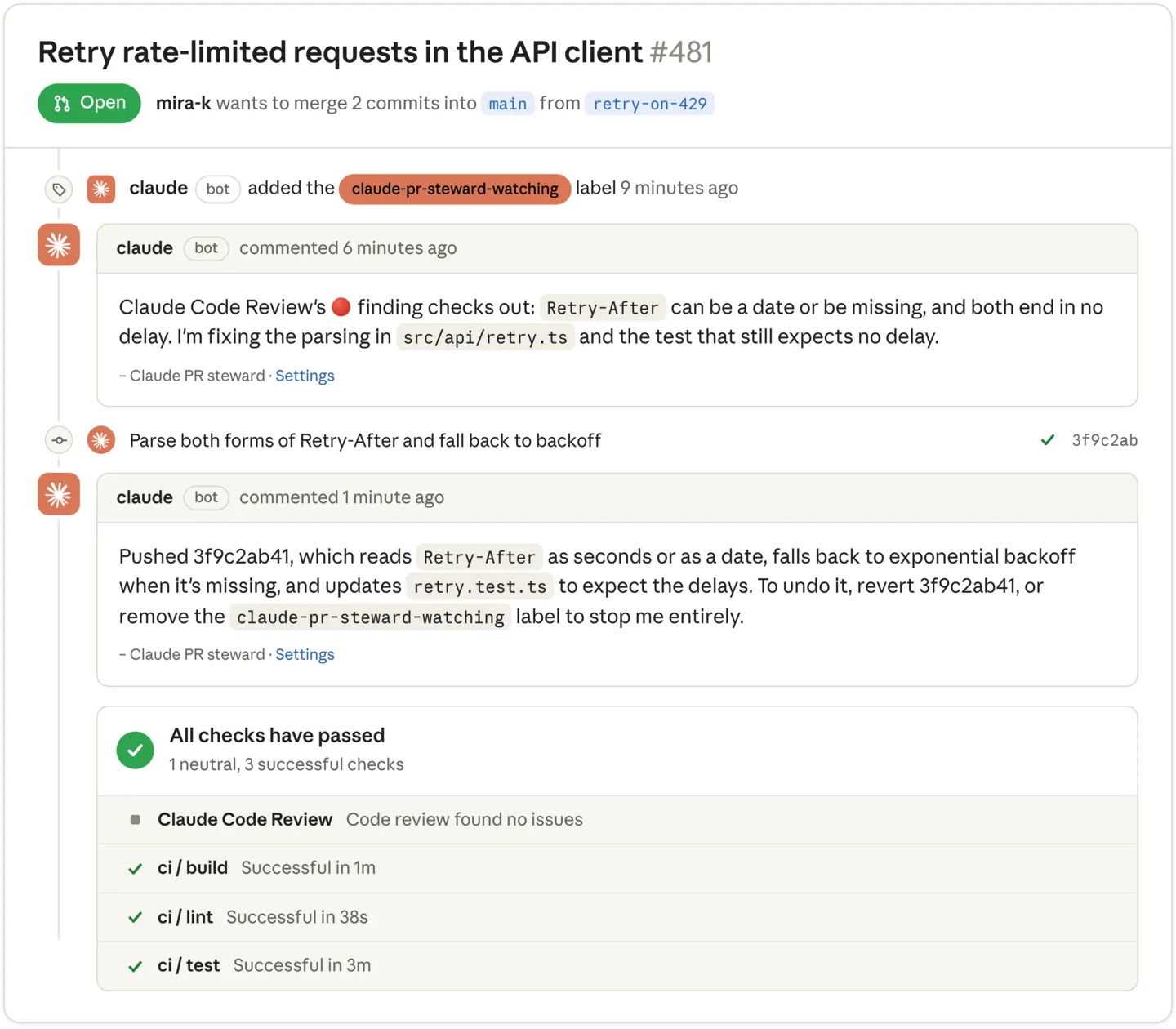
@claude stop ends it. Anthropic launch image, retrieved 24 Nov 2026.1/ship acts first and asks almost nothing
/ship asks for no confirmation. After Enter it can commit every uncommitted change, new files included, push the branch and open the pull request, with a few-second “Esc to cancel” line before the commit and again before the push. It looks for secrets by filename, such as .env, and a Read() deny rule doesn’t keep a file out of the commit.13
Then it watches the pull request for up to seven days from your session, using your credentials. That watch runs code from the base branch it merges in, from other people’s pushes to your branch and from your own tests, and the docs say to run one “only where you trust everyone who can merge to the base branch or push to your branch”. Claude’s own fetches and pushes skip the repository’s git hooks, and the watch’s limits lift for any turn where you type to an idle session.13
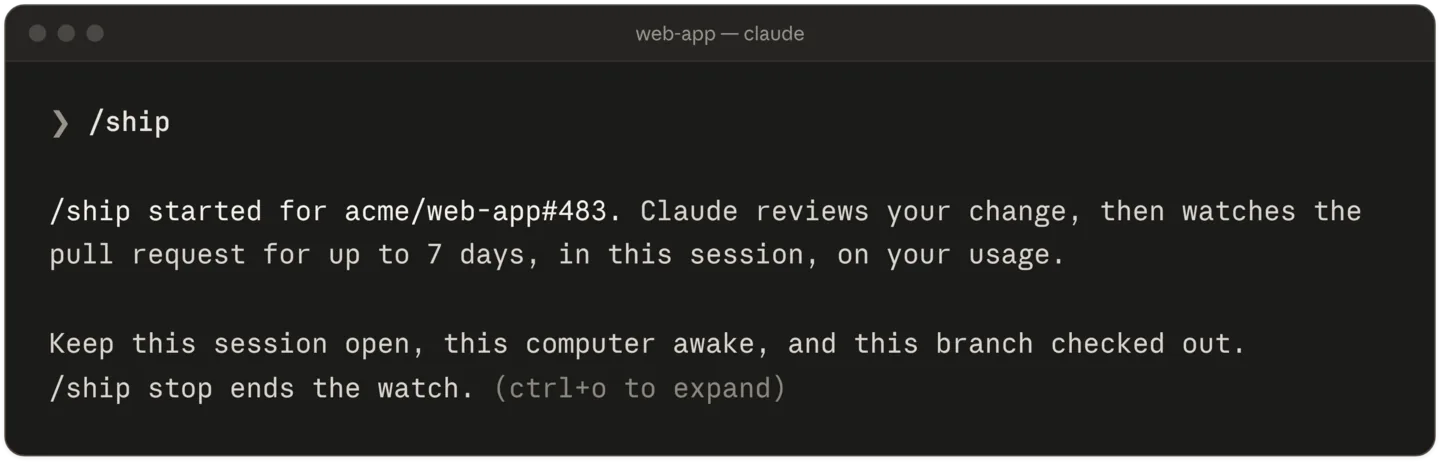
Note: /ship needs Claude Code v2.1.330. An open GitHub issue reports that v2.1.330 blocks new process creation system-wide on Windows, fixed by rolling back to 2.1.329, and a second open issue reports that hook processes don’t sanitise BASH_ENV and PATH from project settings.5051 Both are user reports Anthropic hadn’t confirmed when I checked. A watch doesn’t start on native Windows anyway.13
Day one was loud and unmeasured
Boris Cherny’s launch post set the pitch: Opus 4.5 was “the first model to write 100% of my code”, and “shipping PRs hasn’t caught up”.19 The reach was large. The Hacker News launch thread drew 27 points and 10 comments, and Reddit’s Claude communities produced two posts, one of them removed.182123
- 1.68Mviews of the @ClaudeDevs announcement (1,678,458)
- 931replies and quotes to it
- 27points on the Hacker News thread
- 2Reddit posts in r/ClaudeAI
InferenceNobody in the posts I read had run Ship on a real repository; the most considered Reddit post opened with “I haven’t tried Ship yet, so this isn’t a review of the product”.23 That rests on a sample: 23 X posts against 931 replies and quotes, so treat it as what the visible conversation said, not all of it.
Relief at losing the loop
The appeal was the round trip after a pull request opens. “Finally a reviewer that won’t leave a nit on line 3 and then disappear for lunch.” @kimsubbae11438 A Spanish-language explainer described losing your rhythm when comments or broken tests come back, and the most-viewed practitioner post I found (7,255 views, in Japanese) said the difference from GitHub’s automatic review is that fixes run by themselves and approval rules live in a file.3727
Unease at Claude approving Claude
This was the main objection. “Claude writes, Claude reviews, Claude fixes, Claude approves. This is too scary.” @mxllkm, translated from Chinese36 On Hacker News, one commenter walked the ladder down to “Claude merges the code” and ended “You are here, already, somehow??”21 Another noted that Anthropic’s March Code Review post said it “won’t approve PRs, that’s still a human call”, and that this line is now gone.24 On Reddit, the useful version was a line in the sand: “the line i’d hold is any pr that touches its own tests or the ci config.”23
“We already have this”
“Copilot already has what you made. It was lame and expensive. I hope you do better.” @cyrilgupta25 One practitioner’s comparison credited Ship with pushing its own fixes for CI failures and conflicts, keeping approval rules in a repository file and starting in observe mode.26 Others already run the loop by hand: Greptile reviews, Claude fixes through MCP and CI holds the merge, or an agent proves each pull request against written gates with “a cap of 2 PRs in flight”.3031 On Hacker News: “My teams have already basically settled into doing it this way by building something custom.”22
What would keep people on rival tools
“So I can get rid of coderabbit?”29 The answer offered back was memory: CodeRabbit “remembers that decision for future reviews” when you comment on a pull request.28 Platform gaps came up straight away: “Gitlab when? also, reviews needs context from Linear/Jira too!”32 and a Cursor team said it would reconsider “if Claude Ship supports Bitbucket”.33 One Hacker News commenter saw a different upside: their team writes code with OpenAI models, so a different provider reviewing it is a useful separation.21
Early breakage, and reading the small print
The only bug report I found: “/ship Won’t work if you have remote control on.” @glennsc34 Someone with their own
/shipcommand hoped the built-in “will not break my workflow”.35 And one post did what this page does, pulling the auto-merge warning and the missing Steward spend limit out of the docs.39 Anthropic’s Kevin Martin described Approvals as a way to say whether a change needs “0, 1, or X amount of human reviewers”.20
Coverage the same day, TechCrunch’s included, mostly restated the announcement; its framing was that the approval agent is the new part.52
The only price on record is March’s
No current Anthropic page gives a per-review price for Ship. The costs page says there’s “no flat per-review price” and tells you to run a pilot and read the average off the admin page.4 The only published figure is from Code Review’s research-preview launch in March 2026: reviews “generally average $15–25” and take about 20 minutes, and a support article still says the same.1617 That was before the Quick, Standard and Deep levels.
Show the figures as a table
| Reported | Context | When |
|---|---|---|
| $8 | 10-file PR, a few hundred lines, 9 minutes | Aug 2026 |
| ~$15 | Estimate, reviews run on PR creation only | Mar 2026 |
| $41 | One large PR, found one critical bug | Mar 2026 |
| ~$60 | One run on a toy repo | Mar 2026 |
| $70 | One PR, reviewed once | Aug 2026 |
Pushes multiply that. A Hacker News commenter argued in October that because most pull requests take several commits, each triggering a review, “it’s very easy to rack up $100+ per pr”; that’s an argument, not a bill.42 Effort is a lever too, though not the obvious one: one practitioner’s 144 local reviews of planted bugs found 80%, 85% and 86% at low, medium and high effort, with higher effort mostly cutting false alarms.43 That’s the local command, not the hosted service.
Rivals price by the seat, and one already approves
| Tool | Can it approve? | List price |
|---|---|---|
| Claude Shipthis log | Where the team’s policy allows, in beta from 23 Nov 20268 | Per token; no published per-review figure |
| GitHub Copilot code review | Approvals generally available 28 Oct 2026, counting toward merge rules once enabled44 | not checked |
| CodeRabbit | not checked | $24, $48 or $72 a developer a month billed annually; $30, $60 or $90 monthly45 |
| Graphite | not checked | $20 or $40 a seat a month46 |
| Greptile | Auto-approves a clean 5/5 review, off by default47 | not checked |
| Cursor | PR Routing & Approval can approve low-risk changes; Bugbot itself doesn’t48 | not checked |
InferenceA Gemini Deep Research report put Ship at three to twelve times the cost of seat-priced reviewers at 200 pull requests a month. That multiple is arithmetic on the March average, the same figure the report calls retired, so treat it as low confidence until your own pilot produces an average.1645 GitLab, for its part, had published a Claude Code agent flow for reviews, pipeline fixes and merge conflicts five days before the launch.49
A monorepo has to enforce its root policy first
A directory can carry its own policy file, such as services/billing/.claude/approvals.yml. For each changed file, Approvals walks up to the nearest enforcing policy file, and that file “can ask for less than the root policy file”. Above it, only root rules marked nested: inherit still count.10
The trap is in the mode. Each policy file has its own, and “while the root policy file observes, none of its rules count under a directory’s enforcing policy file, the nested: inherit rules included”.10 A package team that switches to enforce before the root does steps outside the root’s guardrails. A rule can also ask for a Deep review on its own paths with claude/code_review(level=deep); naming a level means the policy starts that review itself, so it adds billed reviews.119
Pilot it the way the docs set it up, not the way the defaults do
InferenceThis order is assembled from the setup and rules pages, not tested here; each step closes one or more of the deferrals in card 02.6912
Check you qualify. Team or Enterprise, GitHub, and none of Zero Data Retention, the HIPAA configuration or customer-managed keys; Approvals needs github.com.28
Branch protection before anything else. A ruleset requiring one approval, stale approvals dismissed on push, the Claude app off every bypass list. This is step one of Anthropic’s own Steward setup.6
Code Review in one repository, on “Once after PR creation” or manual, with a Code Review spend limit; read the per-review average after a handful of pull requests.4
PR Steward on “Manual (@claude steward)” for a listed group of users, with a monthly limit and a per-PR cap set first.6
Approvals in observe mode, keeping
claude/code_reviewunderadvisory, covering every path with root rules that have noif, and adding a classifier-free non-author rule on the paths that matter.912Rules for unprotected files:
.github/,CLAUDE.md,AGENTS.md,.mcp.json.10Enforce only when observe mode’s verdicts match your reviewers’, root first in a monorepo, then pin the required check to app ID
1236702.9Before anyone runs /ship, check
git status, stash what shouldn’t ship, read files for secrets yourself, and start the next change in a second clone.13
What nobody can tell you yet
How well it works. No post I read reports finding quality, false positives, a Steward fix that went wrong, a bad approval or a bill from Ship itself. Nobody has published a monorepo run.21
What a review costs now. The March average predates the review levels, and the bills above predate Ship.16
Copilot’s approval start date. The claim that assessments began on 1 September is unverified; the 28 October general availability is confirmed.2444
Reddit beyond the archive. The Reddit pass used a public archive that lags live Reddit and searches by community, so comment threads under the launch posts may be missing.
The security plugin’s reception. Anthropic’s Claude Security plugin is a separate local tool that scans a repository or a diff, writes reports and patches, and never applies a patch itself. It isn’t part of Ship, and I didn’t look for reactions to it.15
Methods
Claude Code (Claude Opus 5.5) did the reading, checking and drafting under my direction on 24 November 2026, about seven hours after launch. I reviewed the page before publishing.
- Read in full: the launch article, the Claude Ship overview, 13 linked doc pages, the credit terms and the Claude Security page.
- X: Dossier’s free grok search failed on every call (the grok CLI returned “402 Payment Required”), so I ran Dossier’s xAI research backend with X search for about US$1.20, then re-read each of the 23 quoted posts’ text and counts directly, because x.com answers any post link with a page.
- Hacker News through the Algolia API; Reddit through the Arctic Shift archive, 46 of 48 queries returning; a Chrome pass on live Reddit didn’t run.
- A Gemini Deep Research report was audited against its sources: competitor prices and Copilot’s date held; three of its quotes were attributed to the wrong person and one GitHub-issue claim was overstated, and those are corrected here.
- One reading only, by request; the plainer and more technical readings were not written. The page uses Anthropic’s own launch images, captioned and cited.
- Design: reference sections from Mobbin (OpenAI, Klarna, 1Password, Superpower, Sequence) and one parallel-frame ideation run; the look is a maintenance log. No scrubbed or pinned motion, because no claim here changes over scroll.
The claim ledger is claims.json; inferences are marked in the page and in the ledger.
Sources
- Introducing Claude Ship (Anthropic) Launch article; internal merge and revert figures; TELUS and Carvana quotes; launch images · 23 Nov 2026
- Claude Ship docs (Anthropic) Overview, set-up order, billing continues with credits off, turn-off order · accessed 24 Nov 2026
- Code Review docs (Anthropic) Four-stage review; check run never fails; read-only · accessed 24 Nov 2026
- Code Review costs and usage (Anthropic) No flat price; After every push default; spend limits · accessed 24 Nov 2026
- PR Steward docs (Anthropic) When it starts, what it skips, no spend limit until set · accessed 24 Nov 2026
- Set up PR Steward (Anthropic) Branch rules first; Manual mode; caps can be overrun · accessed 24 Nov 2026
- What PR Steward can access (Anthropic) Refused requests; pushes to any branch; reworded commands can pass both checks · accessed 24 Nov 2026
- Claude Approvals docs (Anthropic) Policy file; automatic reviews stop; approves starts no review · accessed 24 Nov 2026
- Set up Claude Approvals (Anthropic) Observe mode billed; enforcement steps; app ID 1236702 · accessed 24 Nov 2026
- Approvals policy file reference (Anthropic) Author seat; protected files; subdirectory policy files · accessed 24 Nov 2026
- Approvals classifiers (Anthropic) Billing per run; what a run reads; level input · accessed 24 Nov 2026
- Claude Approvals and your GitHub rules (Anthropic) Merges without human review; steered classifiers; merge queues · accessed 24 Nov 2026
- /ship and /steward (Anthropic) No confirmation; what a watch runs; hooks skipped; v2.1.330 · accessed 24 Nov 2026
- Claude Ship promotional credits (Anthropic Help Center) $10,000–50,000 by seats; 30 days; claim by 15 Jan 2027 · updated 23 Nov 2026
- Scan your codebase for vulnerabilities (Anthropic) Claude Security plugin; patches never applied automatically · accessed 24 Nov 2026
- Code Review launch post (Anthropic) Reviews average $15–25 and about 20 minutes · 9 Mar 2026
- Set up Code Review for Claude Code (Anthropic Help Center) Still states $15–25 per review · accessed 24 Nov 2026
- @ClaudeDevs launch post (X) Counts read about 03:00 UTC · 23 Nov 2026
- @bcherny launch post (X) 5,086 likes, 379,333 views at check · 23 Nov 2026
- @kvnpmrtn on the three agents (X) Claude Code team, Anthropic · 23 Nov 2026
- Claude Ship (Hacker News) 27 points, 10 comments at check · 23 Nov 2026
- TechCrunch link thread (Hacker News) 4 points, 2 comments · 23 Nov 2026
- “What it should NEVER approve” (r/ClaudeAI) Post and comments · 24 Nov 2026
- @stretchcloud on approvals and pricing (X) Copilot dates and per-PR figure unverified there · 23 Nov 2026
- @cyrilgupta (X) 24 Nov 2026
- @masahirochaen, Copilot comparison (X, Japanese) 24 Nov 2026
- @masahirochaen, launch note (X, Japanese) 7,255 views at check · 24 Nov 2026
- @SumRol on CodeRabbit memory (X) 24 Nov 2026
- @ImAym3n (X) 24 Nov 2026
- @jessecruz on a Greptile and Claude loop (X, Portuguese) 23 Nov 2026
- @JCOMBuilds on a home-built gate (X) 24 Nov 2026
- @uccmen (X) 23 Nov 2026
- @NoldoDev on Bitbucket (X) 23 Nov 2026
- @glennsc (X) 24 Nov 2026
- @sheriffdolx (X) 23 Nov 2026
- @mxllkm (X, Chinese) 24 Nov 2026
- @0xJokker explainer (X, Spanish) 24 Nov 2026
- @kimsubbae114 (X) 23 Nov 2026
- @frasertests1 on the docs (X) 24 Nov 2026
- “Has anyone actually used the new code review” (r/ClaudeCode) $41, ~$60 and ~$15 in the comments · Mar 2026
- “Claude Code Review is costly” (r/ClaudeAI) $8 in the post, $70 in a comment · Aug 2026
- Comment on review cost per PR (Hacker News) 16 Oct 2026
- “High effort mostly cut false alarms” (r/ClaudeAI) 144 local reviews, planted bugs · Nov 2026
- Copilot code review: Max and approvals (GitHub changelog) Approvals generally available · 28 Oct 2026
- Plans and pricing (CodeRabbit docs) accessed 24 Nov 2026
- Billing plans (Graphite docs) accessed 24 Nov 2026
- Config reference, autoApprove (Greptile docs) accessed 24 Nov 2026
- PR Routing & Approval (Cursor docs) accessed 24 Nov 2026
- Agentic engineering with GitLab and your local agent (GitLab blog) 18 Nov 2026
- claude-code issue #111584 (GitHub) Windows freeze on v2.1.330; open · 21 Nov 2026
- claude-code issue #111867 (GitHub) Hook env not sanitised for BASH_ENV and PATH; open · 23 Nov 2026
- Anthropic launches Claude Ship (TechCrunch) 23 Nov 2026
Claude Ship is Anthropic’s product; this page is independent and not affiliated with Anthropic. Back to top